

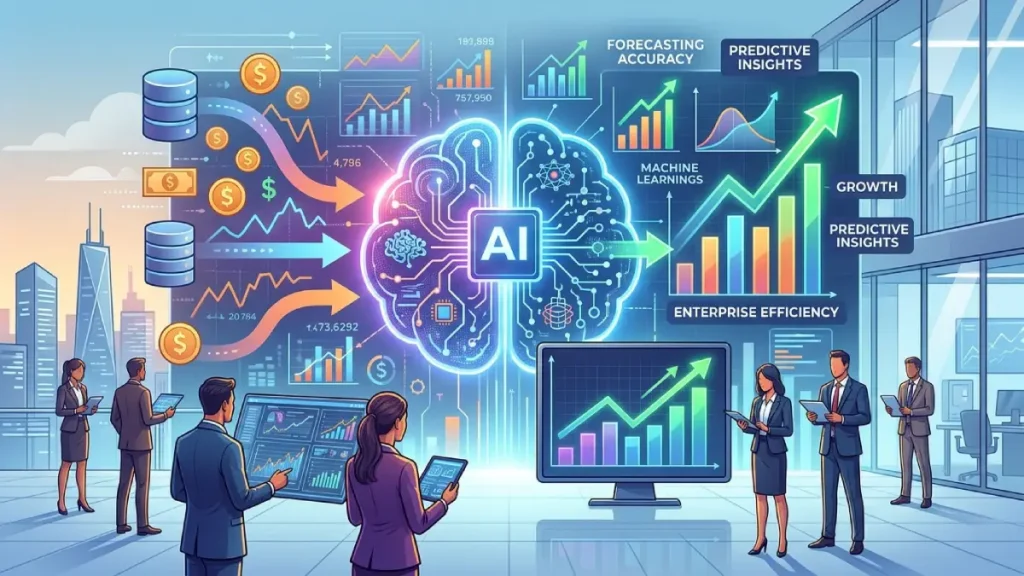
Financial forecasting has traditionally been a complex, data-intensive task. Enterprises rely on historical financial statements, market trends, and human intuition to predict revenue, cash flow, and broader economic patterns. While this approach has been effective to some extent, the modern business environment demands faster, more accurate, and dynamic forecasting solutions. Enter Artificial Intelligence (AI) — a transformative technology that is redefining how companies anticipate financial outcomes, mitigate risk, and optimize strategic decision-making.
The Evolution of Financial Forecasting
Historically, financial forecasting depended heavily on manual analysis. Accountants and financial analysts would aggregate historical data, apply statistical models, and make projections for upcoming quarters. While these methods offered a baseline understanding, they were limited by human cognitive constraints and the quality of data available.
With the advent of advanced computing and data storage, predictive analytics began to emerge. Statistical models, such as regression analysis, ARIMA, and Monte Carlo simulations, provided quantitative insights into revenue trends and market behavior. However, these models still relied on assumptions about market stability and linear relationships — assumptions often invalidated by real-world volatility.
AI, particularly machine learning (ML) and deep learning, has disrupted this paradigm. AI systems can analyze vast datasets in real-time, identify non-linear patterns, adapt to evolving conditions, and even learn from unstructured data sources such as news articles, social media sentiment, and geopolitical events.
Core AI Models in Financial Forecasting
AI-powered forecasting relies on several key models and techniques that allow enterprises to achieve high-precision predictions.
1. Machine Learning Regression Models
Regression models are among the earliest machine learning tools used for predicting financial metrics. Traditional linear regression evaluates relationships between input variables (e.g., sales volume, marketing spend) and outputs like revenue. AI enhances this approach through:
- Non-linear regression: Captures complex relationships in data.
- Regularization techniques (Lasso, Ridge): Prevent overfitting, improving model generalization.
- Feature engineering automation: AI identifies relevant variables that might escape human observation.
2. Time-Series Forecasting with AI
Time-series forecasting is essential for predicting revenue and cash flow over specific periods. AI models, including Recurrent Neural Networks (RNNs) and Long Short-Term Memory (LSTM) networks, excel in analyzing sequential data. These models can:
- Learn long-term dependencies in financial data.
- Detect seasonal trends and cyclic patterns.
- Adapt dynamically as new data becomes available, improving accuracy continuously.
3. Ensemble Methods
Ensemble techniques combine multiple models to enhance predictive performance. For example, Random Forests and Gradient Boosting Trees integrate numerous decision trees to reduce variance and bias. In financial forecasting, this approach helps enterprises:
- Mitigate risk from individual model errors.
- Produce robust forecasts even in volatile markets.
- Identify subtle interactions among financial indicators.
4. Natural Language Processing (NLP) for Market Insights
Unstructured data, such as financial news, analyst reports, and social media commentary, holds critical signals for enterprise forecasting. NLP techniques allow AI to process and interpret textual data to anticipate market shifts. Applications include:
- Sentiment analysis to gauge investor confidence.
- Event detection, such as mergers, regulatory changes, or geopolitical crises.
- Early warning signals for revenue deviations or cash flow risks.
5. Reinforcement Learning for Dynamic Forecasting
Reinforcement learning (RL) enables AI systems to learn optimal strategies by interacting with financial environments. RL models continuously adjust predictions based on observed outcomes. Enterprises leverage RL to:
- Optimize cash reserves and investment allocations.
- Adapt pricing strategies dynamically.
- Improve financial decision-making under uncertainty.
Applications of AI in Enterprise Financial Forecasting
AI’s impact is most evident in practical enterprise applications. Organizations across sectors are leveraging AI to drive strategic decisions and operational efficiency.
Revenue Forecasting
Accurate revenue projections are foundational for budgeting, expansion, and investor relations. AI enhances revenue forecasting by:
- Integrating historical sales data with external factors like seasonality, economic indicators, and competitor activity.
- Simulating multiple scenarios to evaluate potential revenue outcomes.
- Reducing the reliance on subjective human assumptions.
For example, a multinational retail enterprise can use AI to predict regional sales fluctuations based on customer demographics, promotional campaigns, and macroeconomic trends.
Cash Flow Management
Cash flow forecasting ensures businesses maintain sufficient liquidity to meet obligations. AI provides real-time visibility into:
- Accounts receivable and payable trends.
- Short-term and long-term liquidity risks.
- Optimal working capital allocation.
By predicting cash flow shortages or surpluses, enterprises can proactively adjust credit policies, renegotiate supplier terms, or plan investment opportunities.
Market Trend Prediction
Understanding broader market trends is crucial for strategic positioning. AI models can:
- Analyze macroeconomic indicators, industry-specific data, and competitor activity.
- Identify emerging market opportunities and potential disruptions.
- Support portfolio optimization for financial institutions.
For instance, AI algorithms can detect early adoption trends for new product categories, enabling companies to align production, marketing, and investment strategies ahead of competitors.
Risk Assessment and Mitigation
Financial forecasting is incomplete without evaluating risk. AI contributes by:
- Detecting anomalies indicative of fraud or accounting errors.
- Estimating probabilities of financial distress based on multidimensional indicators.
- Modeling the impact of market volatility, regulatory changes, and global crises on revenue and cash flow.
This proactive risk management allows enterprises to safeguard assets and maintain investor confidence.
Case Studies: AI in Action
1. Global Banking Sector
Major banks have integrated AI-driven forecasting systems to improve loan performance predictions. By analyzing historical loan data, customer behavior, and market trends, banks have achieved:
- Reduced default rates by identifying high-risk clients early.
- Enhanced portfolio performance via real-time adjustments.
- More accurate capital reserve planning aligned with regulatory requirements.
2. Retail Enterprises
Retailers leverage AI to predict seasonal demand and optimize inventory levels. Machine learning models ingest data from POS systems, e-commerce platforms, and social media sentiment. The results include:
- Decreased overstock and stockouts.
- Improved customer satisfaction through better product availability.
- Increased revenue via targeted promotions informed by predictive insights.
3. Manufacturing Companies
Manufacturers use AI to anticipate demand fluctuations and production bottlenecks. By combining financial data with supply chain analytics:
- Production planning aligns with forecasted revenue and market demand.
- Cash flow predictions support timely procurement of raw materials.
- Market trend analysis informs pricing strategies and product launches.
Advantages of AI-Enhanced Financial Forecasting
Enterprises adopting AI for financial forecasting enjoy several strategic advantages:
- Accuracy and Precision: AI models capture complex, non-linear patterns that traditional methods miss.
- Real-Time Adaptation: Continuous learning allows forecasts to adjust as new data arrives.
- Scenario Simulation: AI supports multiple ‘what-if’ analyses, helping enterprises prepare for diverse outcomes.
- Resource Efficiency: Reduces manual labor, enabling finance teams to focus on strategy rather than number-crunching.
- Early Risk Detection: Anomalies and deviations are identified before they escalate into major financial issues.
Challenges and Considerations
Despite its benefits, AI implementation in financial forecasting is not without challenges.
Data Quality and Integration
Accurate AI predictions require clean, structured, and comprehensive datasets. Enterprises often struggle with:
- Fragmented data sources across departments.
- Inconsistent data formats.
- Missing historical records.
Investing in data governance and integration frameworks is essential.
Model Interpretability
Complex AI models, especially deep learning networks, are often seen as ‘black boxes.’ Enterprises must ensure:
- Transparency in decision-making.
- Compliance with regulatory standards.
- Trust from stakeholders who rely on forecasts for strategic decisions.
Implementation Costs
While AI can reduce long-term costs, initial deployment requires investment in technology infrastructure, skilled personnel, and data management systems.
Regulatory Compliance
Financial forecasting is subject to regulatory oversight. Enterprises must ensure AI models comply with standards set by bodies such as:
- Canadian Securities Administrators (CSA)
- Office of the Superintendent of Financial Institutions (OSFI)
- International Financial Reporting Standards (IFRS)
The Future of AI in Financial Forecasting
The next wave of AI in enterprise finance is expected to be more integrated and autonomous. Key trends include:
- Augmented Forecasting: Combining human expertise with AI insights for optimal decisions.
- Predictive and Prescriptive Analytics: Not only predicting outcomes but recommending strategic actions.
- Cross-Domain Integration: Merging financial forecasting with operational, HR, and market analytics.
- Explainable AI (XAI): Providing clarity on how AI models reach their conclusions, increasing stakeholder confidence.
As AI becomes increasingly sophisticated, enterprises will move toward fully automated forecasting systems capable of adjusting dynamically to real-time market conditions, enhancing agility and competitiveness.
Conclusion
AI is no longer a futuristic concept in financial management; it is a present-day necessity for enterprises aiming to maintain a competitive edge. By harnessing machine learning, deep learning, NLP, and reinforcement learning, companies can forecast revenue, cash flow, and market trends with unprecedented accuracy and speed.
While challenges such as data quality, interpretability, and regulatory compliance exist, the benefits — improved accuracy, risk mitigation, and operational efficiency — are compelling. Enterprises that strategically integrate AI into financial forecasting are better positioned to navigate market volatility, seize opportunities, and make informed, proactive decisions.
In a world where uncertainty is the only constant, AI is transforming financial forecasting from a reactive exercise into a strategic powerhouse, fundamentally reshaping the way enterprises plan, invest, and thrive.